Artificial intelligence (AI) is transforming the way businesses analyze data. AI analytics, a powerful subset of AI, automates and enhances data processing, helping companies make smarter decisions. But what exactly is AI analytics, and why is it essential for modern businesses?
Let’s break it down in simple terms.
Table of Contents
- 1 What Is AI Analytics?
- 2 AI and Data Analytics in Business
- 2.1 Retail: Personalization and Inventory Optimization
- 2.2 Healthcare: Enhanced Diagnostics and Predictive Analytics
- 2.3 Finance: Fraud Detection and Risk Management
- 2.4 Marketing: Precision Targeting and Campaign Optimization
- 2.5 Supply Chain Management: Predictive Insights and Efficiency Gains
- 2.6 Human Resources: Talent Acquisition and Workforce Optimization
- 3 AI Use Cases: Real-World Applications
- 4 The Future of AI and Data Analytics
- 5 Final Thoughts
What Is AI Analytics?
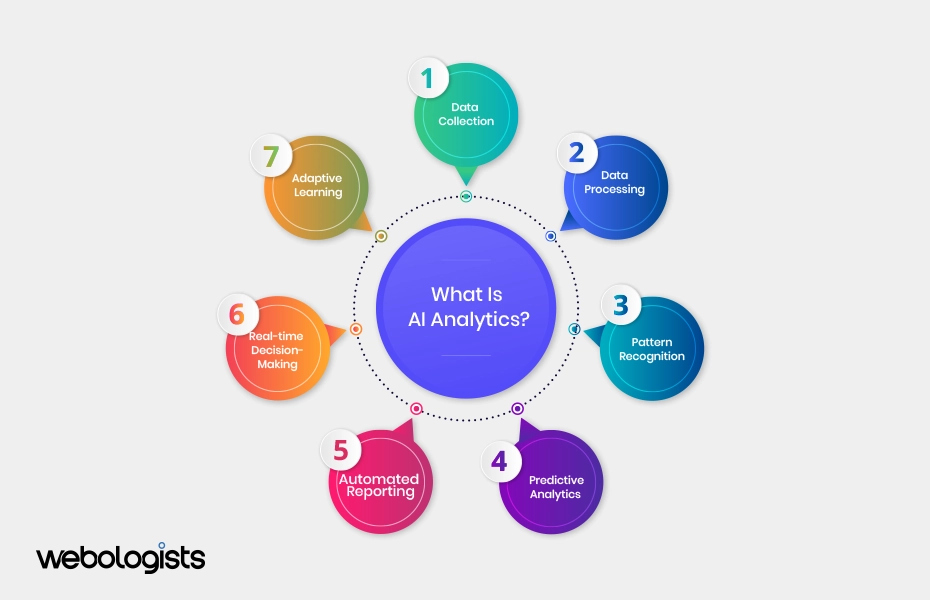
AI analytics refers to the use of artificial intelligence and machine learning (ML) to collect, process, and analyze data efficiently. Unlike traditional analytics, which relies on manual effort and rule-based programming, AI-powered analytics can detect patterns, predict trends, and provide actionable insights with minimal human intervention.
At its core, AI analytics involves:
Data Collection
Gathering structured and unstructured data from multiple sources, including customer interactions, sales figures, website traffic, and social media activity. AI-driven tools can automate this process, ensuring comprehensive data coverage and reducing human errors.
Data Processing
Cleaning, structuring, and organizing raw data to ensure accuracy and eliminate inconsistencies. AI-based systems can detect missing values, remove duplicates, and enhance data quality.
Pattern Recognition
Identifying correlations and trends that may not be evident through conventional analytics. AI can uncover deep insights by analyzing vast amounts of data that humans would take much longer to process.
Predictive Analytics
Forecasting future outcomes based on historical data and real-time inputs. Businesses can leverage AI models to predict sales trends, customer behavior, and market demand.
Automated Reporting
Generating insights and presenting them in easy-to-understand visualizations, dashboards, and reports. AI tools can create real-time data summaries, eliminating the need for manual reporting.
Real-time Decision-Making
AI analytics can provide instant insights, allowing businesses to make informed decisions faster. This is particularly useful in industries like finance, healthcare, and e-commerce where timing is crucial.
Adaptive Learning
Unlike static data analysis models, AI-powered analytics continuously learns from new data, improving its accuracy and effectiveness over time.
AI and Data Analytics in Business
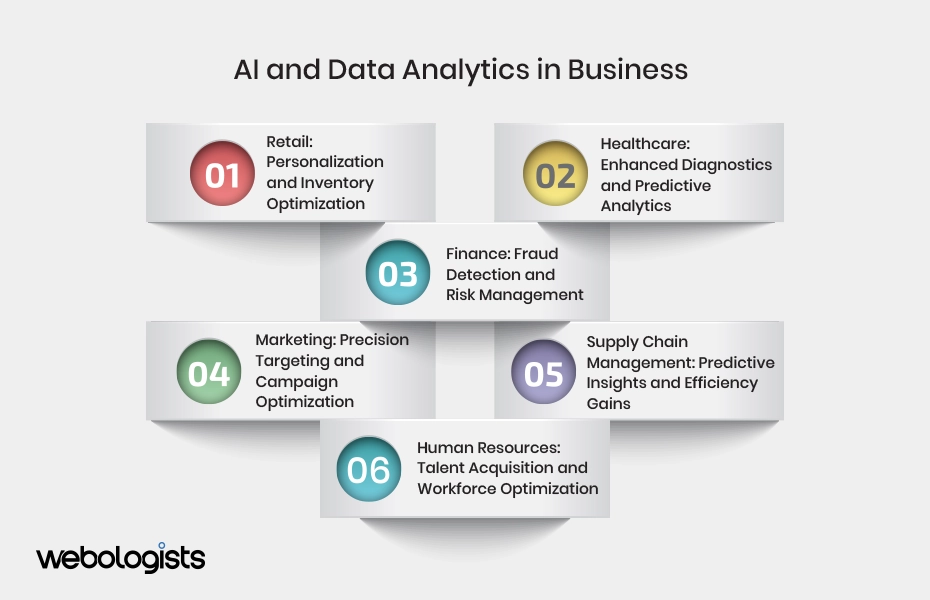
Artificial intelligence (AI) and data analytics are revolutionizing business landscapes across industries. By leveraging machine learning (ML) and big data insights, companies are optimizing operations, enhancing decision-making, and delivering personalized experiences. Let’s see how AI-driven data analytics is driving success across key sectors.
Retail: Personalization and Inventory Optimization
AI analytics is transforming retail by offering deep insights into customer preferences and shopping behaviors. Machine learning algorithms analyze purchase patterns, enabling retailers to recommend products, tailor promotions, and optimize inventory levels. AI-driven demand forecasting helps minimize stockouts and reduce overstocking, enhancing operational efficiency and profitability.
Healthcare: Enhanced Diagnostics and Predictive Analytics
AI-powered analytics is revolutionizing healthcare by assisting in disease diagnosis, treatment planning, and patient outcome predictions. Machine learning models analyze medical records, imaging data, and genetic information to detect diseases at early stages. AI-driven predictive analytics helps hospitals optimize resource allocation and improve patient care efficiency.
Finance: Fraud Detection and Risk Management
Financial institutions leverage AI data analytics to detect fraudulent transactions in real-time, reducing risks and enhancing security. AI agents assess historical transaction patterns to flag anomalies indicative of fraud. Additionally, AI-driven predictive modeling improves credit scoring, portfolio management, and investment strategies, empowering financial organizations with data-driven decision-making.
Marketing: Precision Targeting and Campaign Optimization
AI data analytics enhances digital marketing strategies by segmenting audiences, predicting customer behaviors, and personalizing content. AI-powered sentiment analysis helps brands understand customer opinions, allowing them to refine messaging and optimize engagement. Automated AI tools adjust ad placements, maximizing ROI and improving campaign performance in real-time.
Supply Chain Management: Predictive Insights and Efficiency Gains
AI analytics plays a pivotal role in supply chain management by forecasting demand, predicting disruptions, and optimizing logistics. Machine learning models analyze historical supply chain data to recommend efficient routing, mitigate delays, and reduce costs. AI-driven automation streamlines inventory management, ensuring seamless supply chain operations.
Human Resources: Talent Acquisition and Workforce Optimization
HR departments are integrating AI analytics to enhance recruitment, predict employee attrition, and assess workforce productivity. AI-powered applicant tracking systems streamline candidate screening, reducing hiring biases and improving talent acquisition. Predictive analytics helps HR teams identify patterns of employee engagement and implement proactive retention strategies.
AI Use Cases: Real-World Applications
Here are some key real-world AI applications that showcase its versatility and impact:
Chatbots and Virtual Assistants: Instant Customer Support
AI-powered chatbots and virtual assistants, such as Siri, Alexa, and Google Assistant, analyze customer queries in real-time and provide instant support. Businesses leverage AI-driven chat systems to handle routine inquiries, automate responses, and improve customer engagement.
Sentiment Analysis: Monitoring Brand Perception
AI-driven sentiment analysis helps businesses understand customer opinions by analyzing social media trends, online reviews, and customer feedback. This enables brands to adjust their strategies, enhance reputation management, and proactively address customer concerns.
Predictive Maintenance: Reducing Downtime in Manufacturing
AI-powered predictive maintenance uses machine learning algorithms to detect patterns in equipment performance, predicting potential failures before they occur. This application is particularly valuable in manufacturing, transportation, and energy sectors, reducing costly downtimes and maintenance expenses.
Financial Forecasting: Data-Driven Investment Decisions
AI algorithms analyze historical financial data and market trends to predict stock movements and investment opportunities. Hedge funds, banks, and individual investors use AI-driven analytics for portfolio management, risk assessment, and high-frequency trading strategies.
Personalized Customer Experience: Tailoring Content and Offers
AI enhances customer experience by analyzing user behavior and preferences to personalize content, recommendations, and promotional offers. Streaming platforms like Netflix, e-commerce giants like Amazon, and digital marketing campaigns rely on AI-driven personalization to boost user engagement and retention.
The Future of AI and Data Analytics
AI analytics continues to evolve, offering businesses greater intelligence, automation, and predictive capabilities. The next wave of AI advancements will further refine data processing, decision-making, and business operations.
Edge AI
AI models will process data locally, minimizing reliance on cloud computing and enabling real-time decision-making. By reducing data transmission to the cloud, Edge AI improves response times, enhances privacy, and reduces bandwidth costs, making it ideal for applications such as smart devices, autonomous vehicles, and industrial automation.
Explainable AI (XAI)
Transparent AI systems will allow businesses to understand how AI-derived insights are formed, increasing trust and accountability. XAI ensures that AI models provide clear, interpretable justifications for their decisions, helping industries like healthcare and finance meet regulatory requirements and gain user confidence.
AI-driven Automation
Companies will leverage AI to automate complex workflows, reducing dependency on manual intervention and increasing efficiency. AI-powered robotic process automation (RPA) will handle repetitive tasks, freeing up employees to focus on higher-value work, while AI-driven decision support systems enhance business strategy.
Advanced Natural Language Processing (NLP)
AI will enhance its ability to interpret unstructured data, including emails, voice commands, and social media interactions. Future NLP advancements will improve conversational AI, real-time language translation, and contextual understanding, benefiting industries like customer service, legal, and education.
Integration with IoT
AI and the Internet of Things (IoT) will work together to improve predictive analytics in industries such as healthcare, logistics, and smart manufacturing. AI-driven IoT ecosystems will enable real-time monitoring, optimize energy usage, and enhance operational efficiencies through predictive maintenance and automated decision-making.
Final Thoughts
AI analytics is revolutionizing the way businesses handle data. From improving decision-making to predicting trends, AI-powered analytics is a game-changer. Whether you’re in finance, healthcare, retail, or marketing, AI can provide deep insights and automation capabilities that drive efficiency and growth.
If you’re looking to integrate AI analytics into your business, partnering with a web app development company can help you build intelligent solutions tailored to your needs. AI-driven web applications can enhance customer experiences, streamline operations, and provide a competitive edge in the digital landscape.