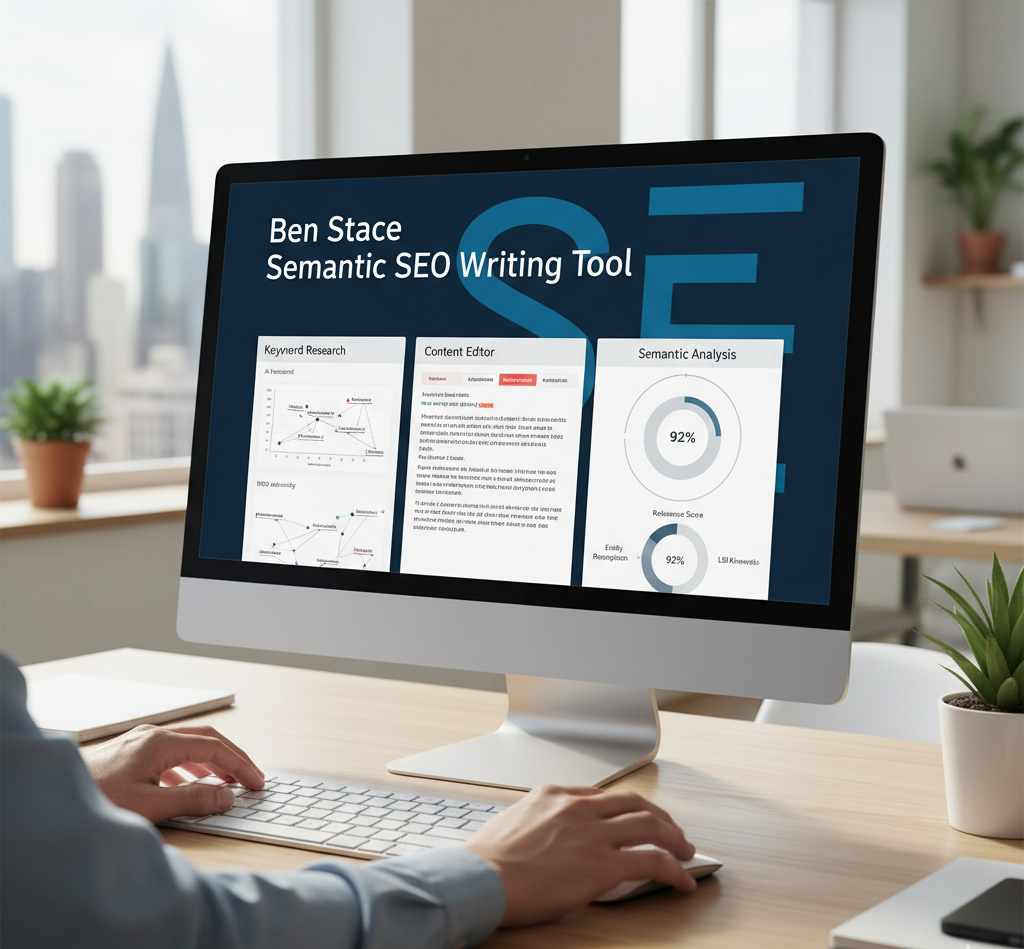

What is the ben stace semantic seo writing tool and how can we go further with it? Who is it for? In this post we explain the tool in plain language, show what works, and give a clear plan Webologists uses to deliver better artificial intelligence assisted SEO content for sites in the UK, US, Canada, Australia, New Zealand, Ireland, and South Africa.
Table of Contents
What the ben stace semantic seo writing tool does
The ben stace semantic seo writing tool helps writers make content that matches meaning, not just repeated words. It finds related terms, maps topics, and checks that content fits user intent. That helps pages rank for many related searches instead of one exact phrase.
Why does this matter? Search engines read relationships between words and entities. They use knowledge graphs and context to answer queries directly. That makes topic-based pages more useful to searchers and to search systems.
How Webologists goes beyond the tool

We use the ben stace approach as a base. Then we add steps that make content more useful to readers and more likely to rank across English-speaking countries.
Clear user intent first.
We decide if the page should teach, compare, or sell. That shapes headings and the tone.
Topic clusters with short pages.
For each main topic we create 4–6 linked pages. That shows search systems the site covers the topic in depth.
Entity and context lists.
We build a short list of entities and nearby terms (for example: product names, places, and common questions). This matches how knowledge graphs and embedding models read pages.
Edit for human tone and locality.
We write for each market (UK, US, Canada, Australia, New Zealand, Ireland, South Africa). Small wording changes and local examples help click rates.
Plain answers and short examples.
Each section uses short sentences and one quick example. This helps real readers and voice queries.
Measure and expand.
We check Search Console to see which long-tail queries appear. Then we add focused Q&A sections where traffic is rising.
Why follow these? Topic clusters and focused editing often produce measurable gains. MarketMuse case studies show big increases; one example reports a 1,570% rise in organic traffic after using topic-depth methods. Another shows a 92% year-over-year rise for a focused project.
A small table that explains the difference
| Step | ben stace semantic seo writing tool | What Webologists adds |
| Main focus | Topic mapping and semantic terms | Localized writing + entity lists + quick examples |
| Content scope | Page-level suggestions | 4–6 page clusters with internal links |
| Measurement | Basic keywords & topic coverage | Search Console query tracking and iterative Q&A |
| Output | Optimized page draft | Market-ready pages, FAQs, and schema |
This table helps us pick changes we can test quickly.
NLP words we use (from Wikipedia and SERP pages)
We include these terms naturally: entity, intent, topic cluster, knowledge graph, context, embedding, semantic relevance, content cluster. Use them where they fit, not to force them.
Competitor check and content gaps
Popular tools (Surfer, Frase, Clearscope, MarketMuse) give keyword lists and on-page scores. That helps writers. But many pages still miss three things:
- Short, local examples for target countries.
- Clear small Q&A sections that match long-tail queries.
- Reference to entities and context that match knowledge graph cues.
We fill these gaps by adding local phrasing, focused FAQs, and entity lists tied to the main pages. Case studies show that filling topic gaps can double or triple organic traffic over months when done correctly.MarketMuse Blog
Practical checklist we use
- State the user intent in one line.
- Make a 4–6 page cluster.
- Add an entity list for each page.
- Add 8–12 FAQs (short answers).
- Add simple schema (FAQ, article).
- Track queries and add content for rising long-tail terms.
Want a copy of this checklist in a content brief? We can make one for your keyword and country.
Quick case evidence
- MarketMuse shows examples where topic-centered work drove a 1,570% traffic rise for a program that expanded content depth.
- Another case study reports a 92% year-over-year organic growth after applying topic mapping and content edits.
These are real examples that support using topic clusters and careful edits.
Final Thoughts
At Webologists, we go beyond traditional tools like the Ben Stace Semantic SEO Writing Tool by blending AI precision with real human creativity. Our approach helps brands write content that not only ranks but also connects with readers. As AI keeps shaping SEO, we focus on what matters most clear communication, search visibility, and meaningful user engagement.
-
What exactly is the ben stace semantic seo writing tool?

A tool and method that focuses on meaning, topic mapping, and related terms for better search relevance.
-
Can Webologists use this for small sites?
Yes. We start small with a single topic cluster.
-
How many pages make a good cluster?
Start with 4–6 pages and add as needed.
-
Do we still need keyword research?
Yes. We use keyword data to find intent and long-tail queries.
-
Should we add schema?
Yes. Simple FAQ or article schema helps search systems read facts.