

In the early days of a startup, Zapier feels like magic. You connect your favorite tools in minutes, automate workflows, and free up hours of manual work all without code. For early traction and testing, it’s a no-brainer.
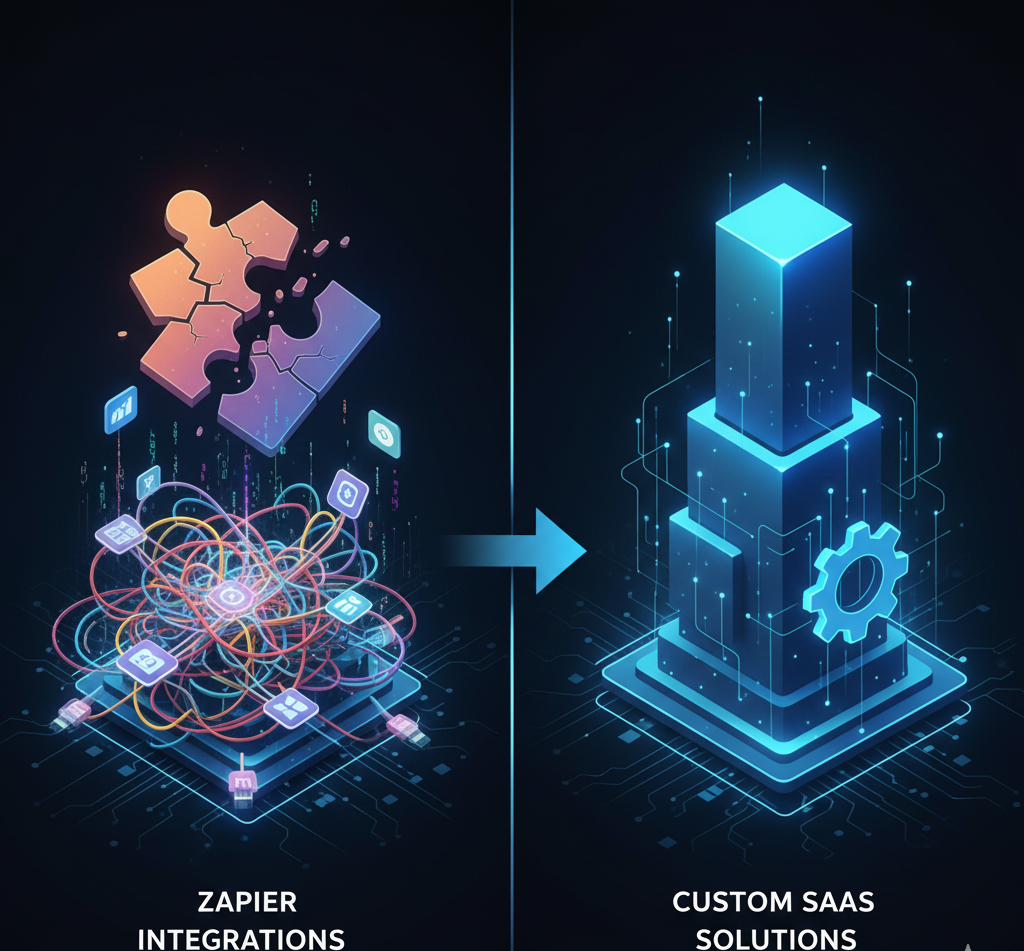
But as your product grows and your team scales, that magic starts to fade. Zaps break. API limits hit. Workflows slow down. And soon, what was once a fast fix turns into a maintenance headache.
That’s why more and more founders are now shifting from Zapier-powered automations to custom SaaS solutions systems built specifically for their workflow, data, and long-term growth.
This guide breaks down why that shift is happening, what founders are learning, and how teams like Webologists help startups move from fragile Zaps to scalable SaaS automation.
Table of Contents
- 1 The Zapier Advantage And Its Ceiling
- 2 1. The Cost Spiral
- 3 2. Limited Custom Logic
- 4 3. Data Ownership and Security
- 5 4. Integration Depth
- 6 5. Maintenance and Scalability
- 7 6. Branding and User Experience
- 8 7. Control Over Future Growth
- 9 When Zapier Is Still the Right Choice
- 10 Signs It’s Time to Move Beyond Zapier
- 11 How Webologists Helps Founders Make the Shift
- 12 Real Example: From 40 Zaps to 1 Smart System
- 13 Why Founders Choose Webologists
- 14 Final Thoughts
The Zapier Advantage And Its Ceiling
Let’s be fair, Zapier is an incredible tool. It democratized automation. You can connect 7,000+ apps, set triggers and actions, and watch data flow without hiring a developer.
For early-stage founders, Zapier helps you:
- Validate workflows before you invest in code.
- Automate simple, repetitive tasks.
- Save engineering time for your product’s core features.
If you’re testing a new MVP or managing light customer operations, Zapier works beautifully. But Zapier has a hard ceiling, one that most growing startups hit sooner than expected.
1. The Cost Spiral
Zapier starts cheap, but costs scale fast. Every extra workflow, every multi-step Zap, every extra task adds to your bill.
Example:
- A founder automating 15 workflows with around 10,000 monthly tasks starts at $49/month.
- Scale that to 100,000 tasks (not uncommon for an active SaaS or eCommerce brand), and you’re easily above $600–$800/month, sometimes more.
That’s before considering downtime, versioning issues, or the time your team spends debugging.
By contrast, a custom automation built once can often replace hundreds of Zaps with zero per-task costs.
Founders are realizing they can recoup Zapier’s annual cost in just a few months by switching to custom solutions.
2. Limited Custom Logic
Zapier is great for linear workflows: If this happens, do that.But most startups evolve beyond that.
You need branching logic, conditional steps, custom data validation, and integration with internal databases. Zapier can’t handle complex dependencies well and even when it can, the setup becomes fragile and hard to maintain.
Custom SaaS systems, however, can mirror your actual business logic. You can integrate CRM, billing, analytics, and user activity in one unified flow and have complete control over how data moves between them.
3. Data Ownership and Security
Every Zap passes data through Zapier’s servers.
That means sensitive information like leads, customer transactions, or financial records travels through a third party.
For many industries (FinTech, Real Estate, SaaS, Healthcare, EdTech), that’s a risk.
When you move to a custom SaaS automation, you control where your data lives. You can host it on your own servers, add encryption, and set compliance to match your industry standards (like GDPR, SOC 2, or HIPAA).
For founders scaling into regulated or enterprise markets, that’s a must-have.
4. Integration Depth
Zapier works at the surface level it connects APIs, not deep system logic.
Let’s say you’re building a SaaS platform that triggers actions based on user subscriptions, custom pricing tiers, or internal API events.
Zapier can’t easily tap into those layers.
Custom integrations, however, can:
- Access internal APIs.
- Sync bi-directionally.
- Handle error logging, retries, and queue systems.
- Run background tasks without time limits.
In short, custom SaaS integration becomes part of your system, not just something glued on top.
5. Maintenance and Scalability
As your startup grows, maintaining 50+ Zaps becomes a nightmare.
- APIs change and Zaps break.
- Tasks get throttled.
- Debugging takes hours.
Founders spend more time maintaining automation than using it. In a custom SaaS build, the same workflows can be structured as microservices or API endpoints that scale automatically.
You can add logging, notifications, and monitoring to catch issues before users do.
This level of control turns automation from a temporary fix into a long-term system.
6. Branding and User Experience
Zapier is invisible to users which is fine when you’re automating backend tasks. But what if you want automation as part of your customer experience?
Example:
- A SaaS company lets users import data from other platforms.
- A Real Estate portal syncs property data from multiple CRMs.
- An EdTech tool connects with Zoom, Stripe, and Google Classroom.
You could patch this with Zap but it looks unprofessional, and you can’t style or brand it.
Custom SaaS integrations can be white-labeled, branded, and deeply embedded — creating a seamless experience that feels built-in, not bolted on.
7. Control Over Future Growth
The biggest advantage of custom automation isn’t what it does today, it’s what it enables tomorrow.
When you own your integration stack, you can:
- Add AI automation (like LLM-based data handling or natural language queries).
- Connect new tools instantly without waiting for Zapier to support them.
- Keep scaling without paying per-task fees.
At Webologists, we often help founders go from Zapier MVPs to AI-powered SaaS systems where automations are smarter, faster, and built to evolve with the business.
When Zapier Is Still the Right Choice
We’re not anti-Zapier it’s a great tool for the right stage.
Here’s when it still makes sense:
- You’re testing an MVP or side project.
- You need quick, temporary workflows.
- You don’t have engineering resources yet.
In fact, we often encourage clients to start with Zapier, gather proof of concept, and then migrate to custom once the workflows are stable and high-volume.
The key is knowing when to make that switch.
Signs It’s Time to Move Beyond Zapier
Founders usually see the red flags before they act.
Here are common signs it’s time to transition:
- Your Zapier bill is higher than your CRM cost.
- You have more than 20+ active Zaps running daily.
- You spend hours fixing or checking workflows each week.
- You hit task limits or API caps regularly.
- You need deeper control over data or branding.
If this sounds familiar, your automation has outgrown Zapier and it’s time to move to something purpose-built.
How Webologists Helps Founders Make the Shift
At Webologists, we specialize in Custom SaaS and AI-powered automation systems that replace patchwork Zaps with unified, intelligent workflows.
Here’s how we help founders transition smoothly:
1. Audit Your Existing Automations
We review your current Zapier setup, task volume, and data flow to find where your business loses time or money.
Our team identifies which automations are worth rebuilding and which can be optimized.
2. Design a Custom Workflow Map
We map how your data moves across CRM, billing, support, analytics — and design a lean automation architecture that mirrors your exact process.
3. Build Lightweight Custom SaaS Integrations
Using your preferred tech stack, we build modular automations API-first, cloud-hosted, secure, and scalable.
Each component is designed to evolve as your business grows.
4. Integrate AI & Predictive Logic
We often layer AI to make automations smarter for example:
- Predicting when to trigger a workflow based on user behavior.
- Cleaning or enriching data automatically.
- Generating reports or alerts with natural language prompts.
5. Monitor, Optimize, and Scale
We don’t just build, we help you maintain and scale.
With dashboards and monitoring tools, you can track performance, uptime, and ROI from one place.
Real Example: From 40 Zaps to 1 Smart System
One of our clients, a SaaS analytics platform, was running nearly 40 Zapier automations connecting HubSpot, Slack, Notion, and Stripe.
It worked fine until usage doubled.
Zaps started failing, data mismatched, and monthly costs shot past $700.
We rebuilt the same workflow as a custom microservice system:
- Built on Node.js and Firebase
- Integrated directly with all APIs
- Monitored in real-time
The result?
Zero failures in 3 months, 70% faster processing, and full visibility into every data sync all for less than their 3-month Zapier bill.
That’s the power of moving from Zapier to custom SaaS automation.
Why Founders Choose Webologists
Founders choose Webologists because we bridge speed and strategy. We understand both startup velocity and long-term scalability. We’ve built SaaS automation for industries like FinTech, Real Estate, EdTech, and Productivity and we know how to keep systems lean, fast, and AI-ready.
Our focus:
- Build smarter workflows with fewer moving parts.
- Cut ongoing costs by removing per-task pricing.
- Help you own your data and scale confidently.
When you work with Webologists, you’re not just hiring developers. You’re partnering with automation strategists who understand product-led growth.
Final Thoughts
Zapier is an amazing place to start but it’s not where founders stay.
As your startup matures, you need control, scalability, and ownership that only a custom SaaS automation can provide.
Teams like Webologists help you make that shift from patchwork Zaps to purpose-built automation, so your systems scale as fast as your vision.
If you’re ready to outgrow Zapier and own your automation future, get in touch with Webologists today.
-
Why are startups moving away from Zapier?

Many startups find Zapier expensive at scale and limited in customization. Custom SaaS solutions offer better control and long-term cost savings.
-
Is building a custom SaaS solution more costly than Zapier?
At first, yes. But over time, custom SaaS apps reduce subscription costs and offer flexibility that Zapier automations can’t provide.
-
Can small businesses still use Zapier effectively?
Absolutely. Zapier is great for testing ideas or automating simple tasks. But as your system grows, custom SaaS becomes more efficient.
-
How long does it take to replace Zapier with a custom app?
Most small to mid-sized projects take between 4–8 weeks, depending on complexity and required integrations.
-
What are the biggest benefits of custom SaaS over Zapier?
Custom SaaS offers full control, deeper data integration, better scalability, and improved performance without recurring per-zap fees.